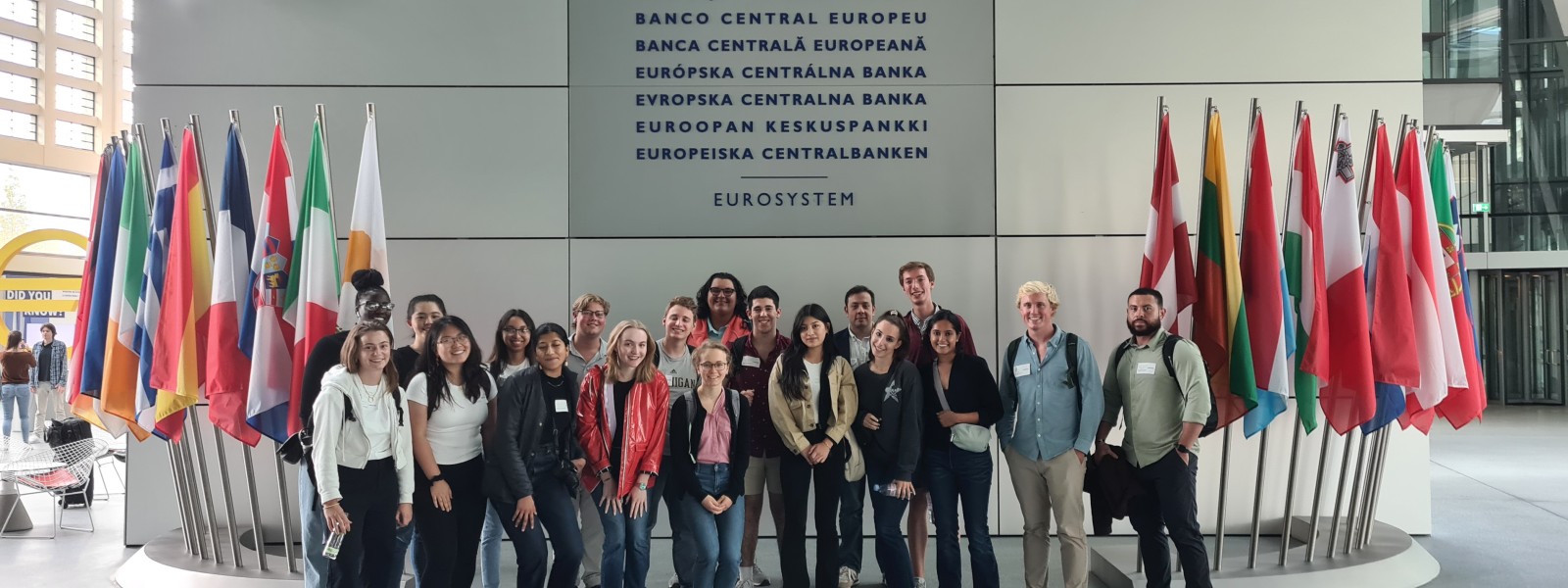
The College’s September Law, Letters, and Society (LLSO) course in Paris provides undergraduate students with the opportunity to earn an upper-level LLSO credit by exploring European perspectives and institutions focused on economy, law, and globalization.
The September 2026 program will take place from Friday, August 28, 2026 through Sunday, September 20, 2026. Participants will be required to commit to the full duration of the program in line with these dates.
- accommodation
- instruction
- student support
- program excursions
- emergency travel insurance (ISOS)
- round-trip airfare to and from the program site
- passport/visa fees
- transportation on site
- meals
- course materials
- personal entertainment and travel
- communications (including cell phone usage)
- health insurance and upfront payments for care
- other miscellaneous expenses
September 2026
Comparative Constitutional Rights Jurisprudence
Shamshad Pasarlay, Assistant Instructional Professor in the Social Sciences Collegiate Division
This course examines how courts in diverse constitutional systems interpret, construct, apply, and give meaning to fundamental/constitutional rights. It also explores the global spread of constitutional rights and how these rights are formally established and structured within constitutional texts. Besides the content of constitutional rights, the major themes covered in the course include the structure and scope of fundamental rights, the use of proportionality and constitutional balancing, as well as the vertical and horizontal effects of rights in constraining both state and private actors. Furthermore, the course examines how social and economic rights are embraced in national constitutions and how courts enforce them to highlight the doctrines, methods, reasoning, and mechanisms that give effect to these rights across diverse jurisdictions. We draw not only on case law from well-studied Western liberal democracies, including the United States, France, Germany, Australia, Ireland, and Canada, but also from the Global South, including India, South Africa, Colombia, Argentina, and other understudied constitutional jurisdictions. The main objective of the course is to provide a truly comparative perspective on constitutional rights jurisprudence and to help students engage critically with the underlying principles, theories, and normative questions that shape the design and enforcement of constitutional rights worldwide.
Apart from classroom work, the September LLSO program offers a series of excursions to sites of academic and cultural interest within and around Paris. Indeed, Paris itself plays a central role in components of the curriculum as detailed above and students will be expected to make full use of its cultural resources.
Faculty who teach on this program rotate from year to year. The faculty roster is designated by the program faculty director.
Headquarters for the College’s study abroad programs in Paris is the University of Chicago John W. Boyer Center in Paris, the University’s teaching and research hub in Europe. Since 2003, the Center has been home to a growing array of the College’s hallmark Study Abroad programs and has supported our community of students, faculty, alumni, and partners from around the world. Designed by Studio Gang, the new Center features state-of-the-art classrooms, offices, event and reception spaces, and gathering areas for students, among other features.
Students in the Paris September LLSO program are housed in a residence hall within the Cité Internationale Universitaire (Cité). The Cité, a park-like residential complex in the fourteenth arrondissement, is the international student campus in Paris, though French students also live there. Students reside in single rooms with a private bath and have access to Cité facilities, including a library, theater, laundry, and athletic facilities. Students will have access to common kitchens in the residence halls and can purchase inexpensive meals at the Cité’s restaurant universitaire.
It is important to recognize the cultural context of student housing in France and understand that the amenities of dormitory facilities may vary. Although some of these differences may take some getting used to, remember that cultural differences extend to all aspects of your experience abroad. Having realistic expectations for your term in Paris will help you approach the study abroad experience with a positive attitude.
Participants in the Paris program will take and receive credit for one Law, Letters, and Society course (100 units). This course is considered part of the students’ Summer Quarter course load and is recorded as a course enrollment on their Summer Quarter registration. The course credit is an upper-level credit for LLSO majors. The course title, units of credit, and grade are placed on the College transcript.
Completion of a September course abroad will earn students 1 point toward Global Honors, the College’s recognition of exceptional global engagement. Visit the Chicago Language Center’s website for information on how to apply for Global Honors.
Study abroad students pay regular Summer Quarter tuition at the one-course rate, a program fee, and a nonrefundable study abroad administrative fee. The tuition and program fee are paid in conformity with the home campus payment schedule, and a deposit toward the nonrefundable study abroad administrative fee is submitted when accepting a place in a program. Precise figures for the Paris September program during the 2025-2026 year are listed below:
Summer tuition for one course: $4,980 (Summer 2026)
Study abroad administrative fee: $675
Paris September program fee: $4,000
Program fee includes:
Out-of-pocket expenses include:
Previous program participants report spending in the range of $200 to $250 per week on meals and incidentals while on the program, though frugal students may spend less, and others could spend much more. Bear in mind that the cost of living in Paris is relatively high and that, while it is possible to live frugally, it is also possible to run short of money if you are unwary. It is therefore essential that you budget your funds prudently, apportioning your resources so that they last for the duration of the program. If you are planning to travel before or after the program or on weekends, you should budget accordingly.
Participants in summer College-sponsored programs are eligible for need-based financial aid, following the procedure described on the Summer and September Aid page of the Financial Aid website. For more information about financial aid resources, please see our general Tuition, Fees, and Funding section.
While the Paris September LLSO program is open to all University of Chicago undergraduate students, priority consideration is given to Law, Letters, and Society majors. Applications from outside the University are not accepted.
The program is designed for undergraduates in good academic and disciplinary standing who are beyond their first year in the College. While the program stipulates no minimum grade point average, an applicant’s transcript should demonstrate that they are a serious student who will make the most of this opportunity. Because the course is taught in English, there is no language prerequisite.
Each application is examined on the basis of the student’s scholastic record and personal statement. If you are interested in applying for this program, please fill out the online application.
To discuss the Law, Letters, and Society September program and the possibility of participating, please contact Damaris Crocker De Ruiter.